 In this area
The Split issue
Grad, Split: Living Inside Diocletian’s Palace
Split’s Old Town is not a preserved ruin but a lived-in Roman palace, where the day starts with cathedral bells, ends with wine glasses on limestone, and rewards anyone who slips one lane off the main drag.

By Ante BuljanMarjan trails and the Adriatic coast
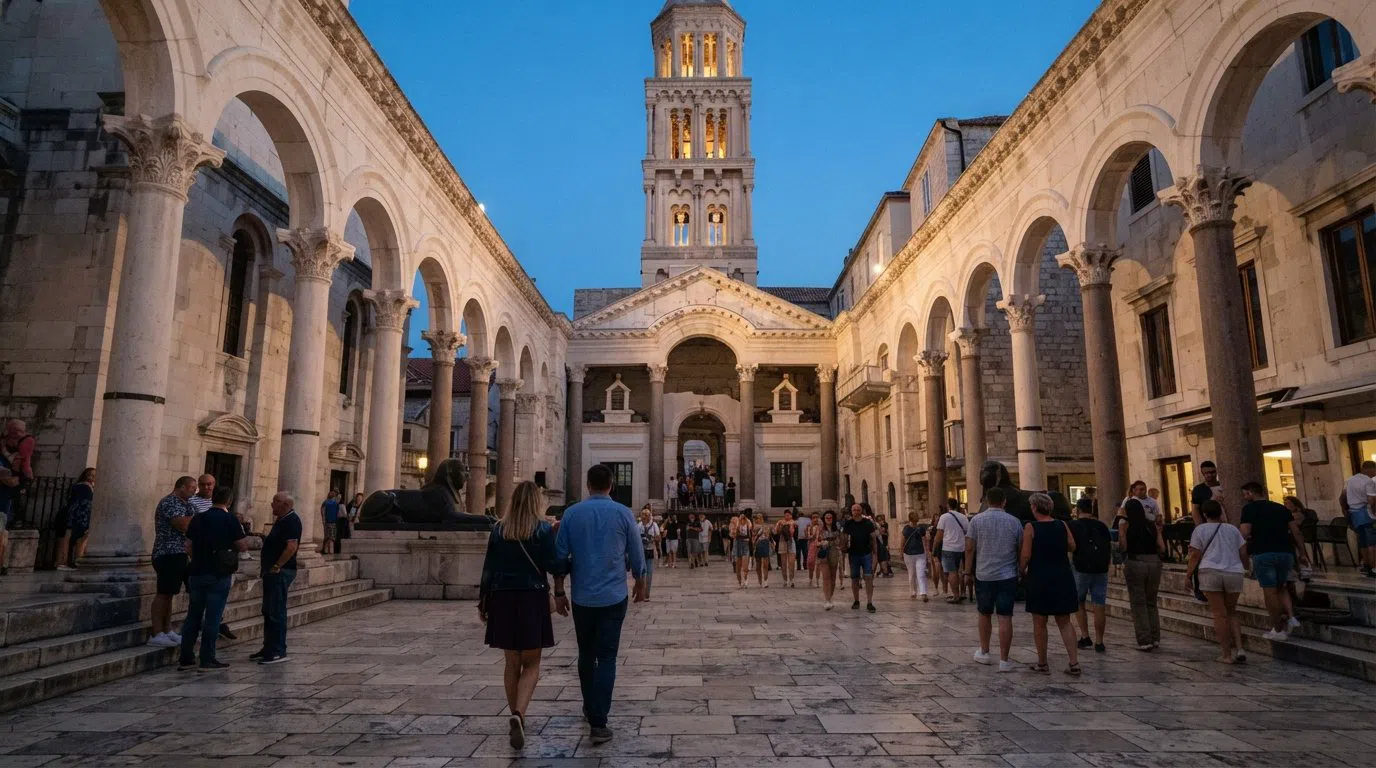
The first thing you notice in Grad is the floor. It shines in a way stone should not, polished by 1,700 years of feet and by the present-day rush of sandals, rolling suitcases and the odd hurried local cutting through the crowd with a sack of groceries. Then the bells start from the Cathedral of St Domnius, and the whole palace seems to breathe. Diocletian built these walls around AD 305, but nobody ever let the place become a museum. People still live here, still hang washing between columns he paid for, still open wine bars in old cellars and roast coffee under arches that once held up an emperor’s apartments. That is the joke and the miracle of Grad: it is the main sight in Split, and also a neighbourhood with errands, habits and a stubborn pulse of its own.
What Grad (Old Town) is known for
Grad is Diocletian’s Palace, and Diocletian’s Palace is Grad. The simple version is that you come for the UNESCO-listed old town; the truer one is that you come to see how a Roman skeleton can still carry a modern city on its back. The palace is compact enough to cross in ten minutes, confusing enough to wander in for an hour, and best seen either early morning or after dark, when the lanes belong again to the people who live and work here rather than to the tour flags.
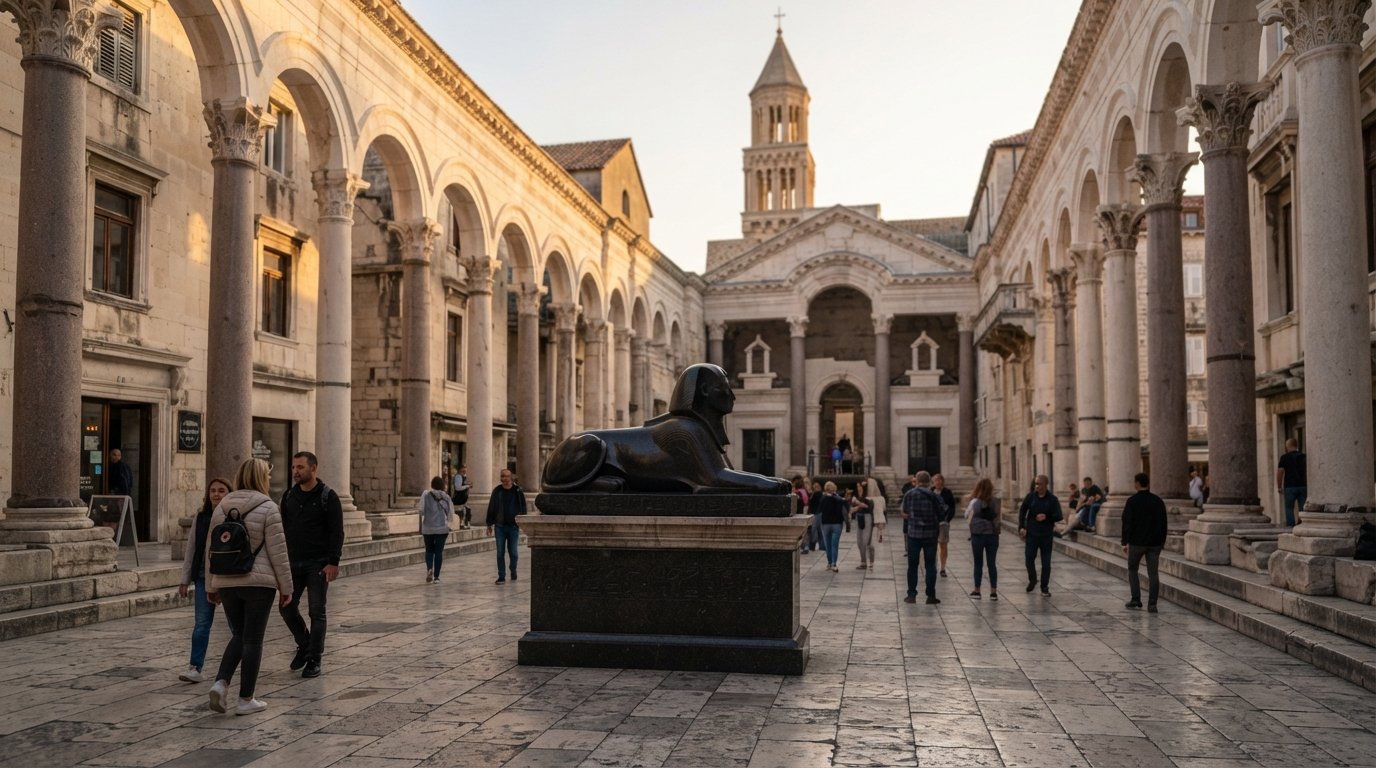
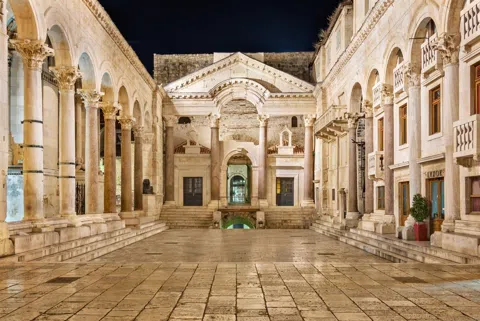
Start at the Peristyle, the ceremonial heart of the palace, where the columns gather around you and an original black granite sphinx from Egypt sits with the sort of calm only imported stone can manage.
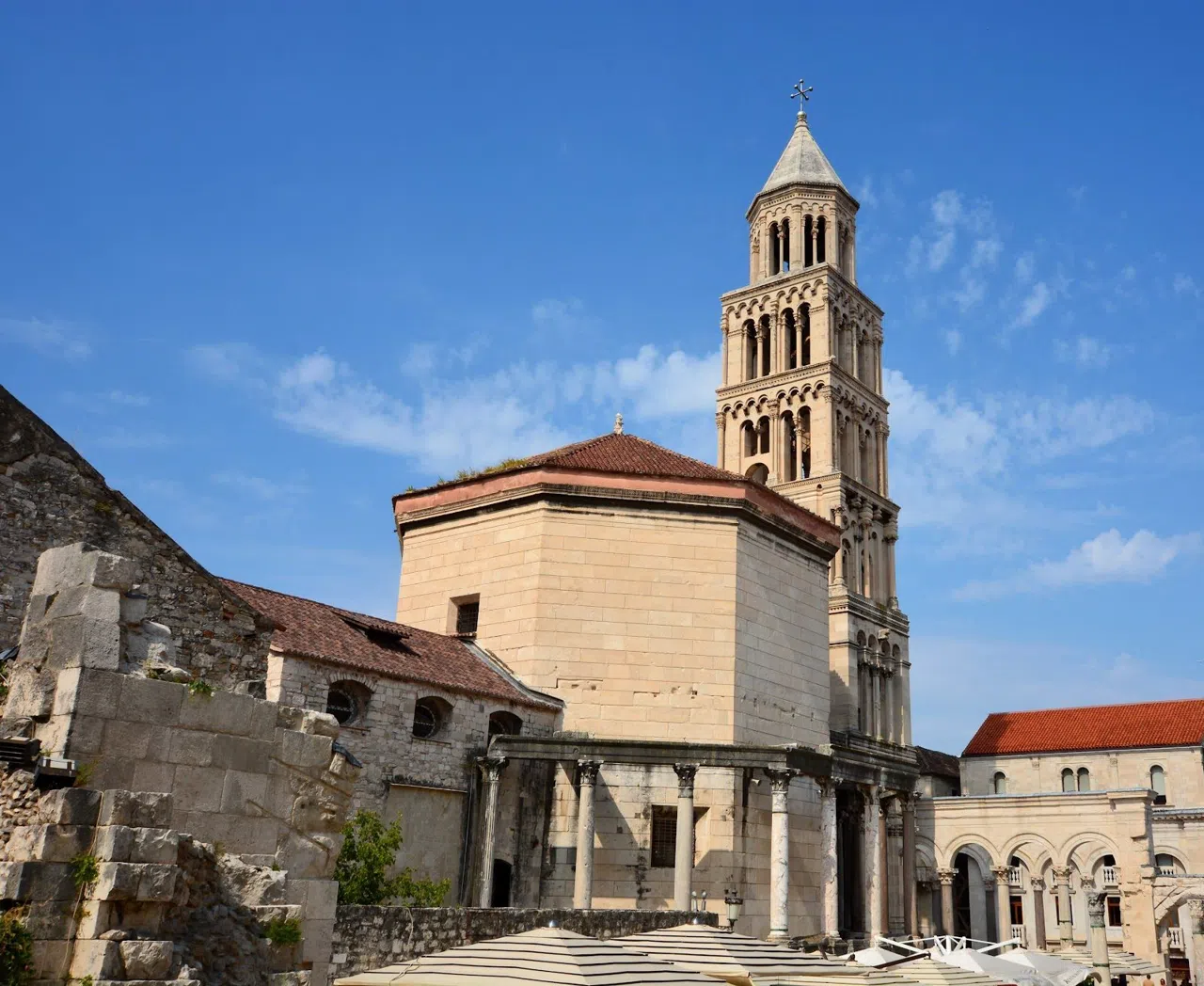
From there, the place opens and closes on you at once. The Cathedral of St Domnius rises from what was once Diocletian’s mausoleum, which is the kind of historical irony the city wears without fuss. Beside it, the bell tower asks for a few hundred narrow steps and returns the favour with the best rooftop view in Split. The combined cathedral-and-tower ticket runs roughly €10–€15, and the hours are broadly 8am–8pm in summer, shorter in winter, so check at the Peristyle booth rather than assuming anything. Below, the cellars spread out in vaulted Roman halls that once supported the emperor’s apartments and later played Meereen in Game of Thrones. A ticket for that section costs a few euros, which is a small price for standing under the bones of the palace itself.
Walk north and the Golden Gate takes you out to Gregory of Nin, Meštrović’s giant bronze bishop from 1929. His golden toe has been rubbed smooth by decades of hopeful hands. Split has always liked a practical superstition.
The old centre works because it is not frozen. A Renaissance palazzo sits wedged into an imperial wall. A café terrace occupies what was once part of a Roman court. A laundry line sags between stone blocks that have seen empires come and go. The lanes are narrow, the surfaces slick when wet, and the whole place has enough stairs to remind you that beauty here was never designed with luggage in mind.
Plan your Split trip
Live prices from our booking partners.
Guests & rooms
Free cancellation on many rooms. We may earn a commission when you book.
Where to eat & drink
The palace lanes are aimed at visitors, yes, but that does not mean you have to eat badly. You just need to know which door to push and when to turn up.
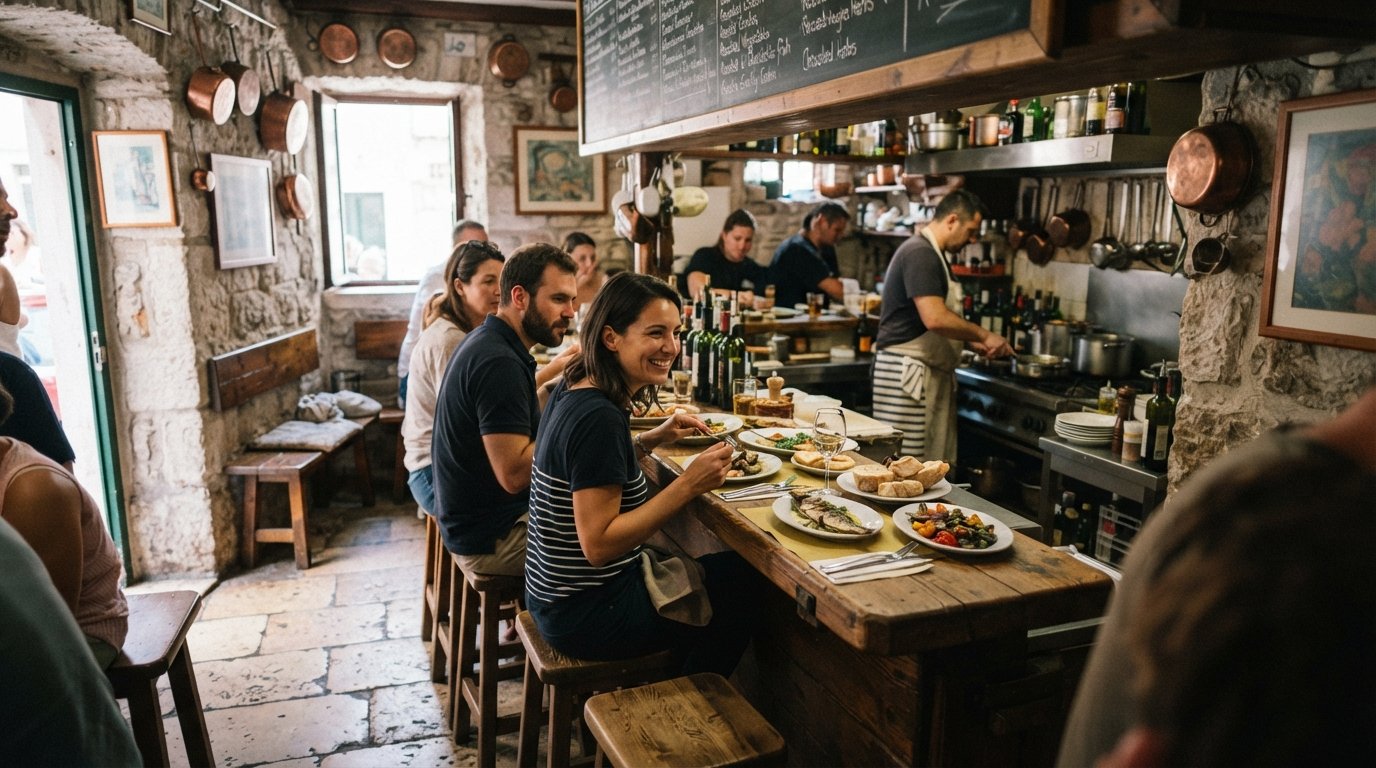
Villa Spiza on Ulica Petra Kružića is the local shorthand for eating well inside the walls. It is tiny, cash only, and built around a chalkboard menu that changes daily with whatever the morning market has brought in — grilled catch, octopus, a pasta or two, and not much ceremony beyond that. It takes no reservations, opens at 1pm, and if you arrive later you may well stand around with a beer and wait your turn. That is part of the deal. The room is small enough that everyone notices what everyone else ordered, which is useful when the plates start moving.
Down Bajamonti Street, near the Iron Gate, Mazzgoon is a family-run kitchen with a hidden courtyard terrace and a little more polish. The focus is on homemade pasta and Adriatic seafood — prawns, octopus, the sort of cooking that knows when to stop. It feels tucked away without trying too hard, which is rarer than it should be in an old town.
Bokeria Kitchen & Wine is the buzzy all-day room in a converted old ironworks, and it behaves like it knows exactly how busy it is. The Mediterranean plates are broad-shouldered, the Croatian-and-international wine list is serious, and reservations are essential. If you want a place that can carry you from lunch to a late glass without changing rooms, this is the one.
For a lighter stop, Fig Split does creative, largely vegetarian and vegan cooking in a sun-filled palace courtyard. It is the sort of place that saves your energy when the stone heat starts to press back at you.
At the top end, ZOI is built into the southern palace wall above the Riva and goes straight for the view as well as the plate. The tasting menus run around €110–€135, and the terrace looks out over one of the best dinner scenes in Split. This is the place for when you want the city to do some of the talking for you.
Finish with Luka Ice Cream & Cakes by the yellow HNK theatre, where the gelato has been a local favourite since 2014 and the dairy- and gluten-free options matter as much as the classics. Or take a proper espresso at D16 Coffee, the specialty roaster inside the walls, where single-origin espresso and pour-overs are treated as they should be: with attention, not theatre.
Going out
Grad does atmosphere rather than clubs. If you want beach-terrace DJ nights until dawn, you walk ten minutes east to Bačvice. Inside the walls, the night is slower and better for it. It begins with shutters opening in cellars, candlelight catching on old stone, and the sound of glasses being set down carefully on uneven tables.
The signature stop is Marvlvs Library Jazz Bar on Papalićeva Street, set in a 15th-century house said to be the birthplace of Marko Marulić, the father of Croatian literature. It keeps its genuine old stone floor and timber-beamed ceiling, shelves of donated books in a dozen languages, and jazz on the stereo, with the occasional poetry night. You do not go there for spectacle. You go because the room feels like it has remembered how to be a room.
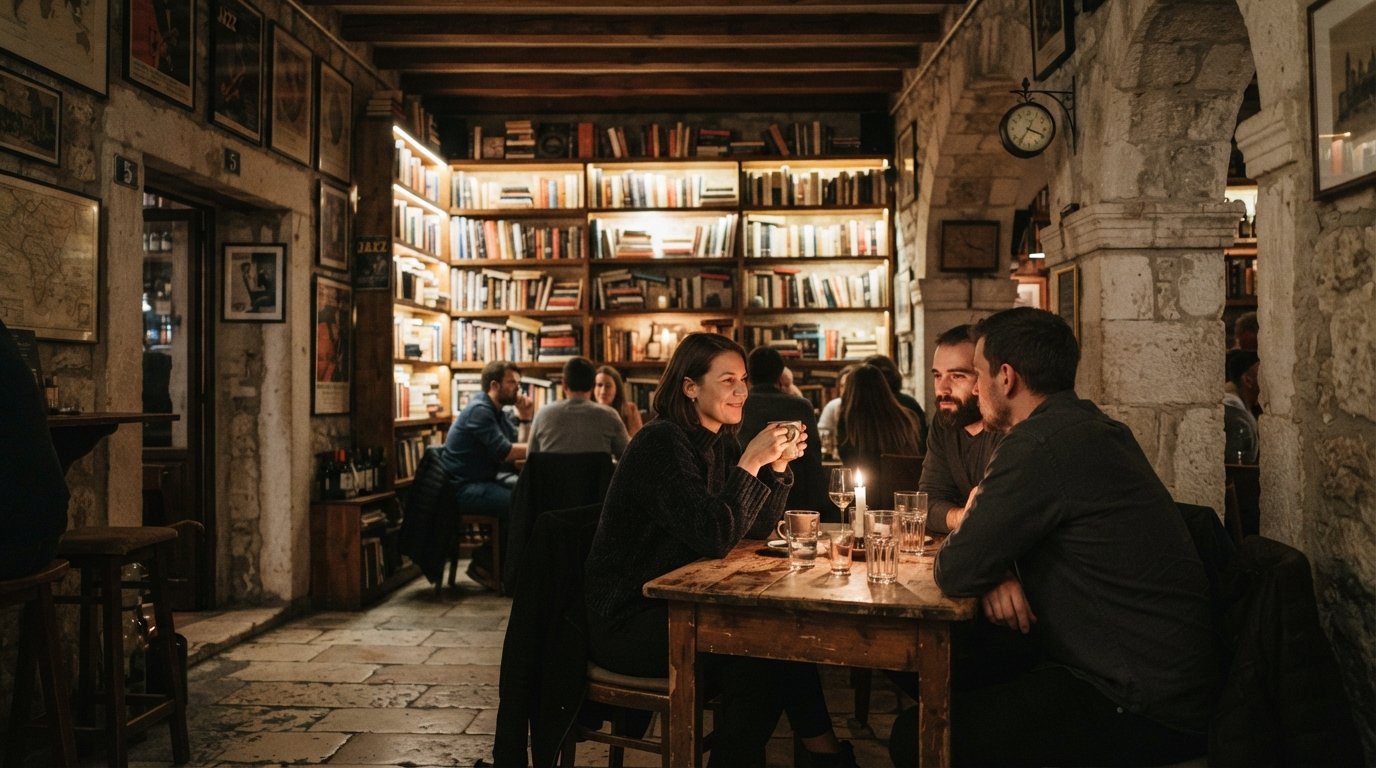
A little rougher around the edges, and all the better for it, Academia Ghetto Club sits in a courtyard off the stepped Dosud passage. It has been Split’s bohemian art bar since the late 1990s, with muralled walls, a candlelit yard, a gay-friendly crowd, live music and exhibitions. It is the place you end up when the evening has stopped being tidy.
On the Peristyle itself, Lvxor lays cushions on the Roman steps in warm weather so you can nurse a drink on the emperor’s own courtyard while live music plays. You are paying a premium to sit on 1,700-year-old stone, which is either the point or a tourist tax depending on your mood. There is no point pretending otherwise. The view is real, and so is the mark-up.
For a more wine-led night, Zinfandel Food & Wine Bar keeps more than 100 Croatian wines, around 30 by the glass, and a menu of Dalmatian small plates. It is the sort of place that lets you keep the evening civilized without making it stiff.
Things to do / what to see
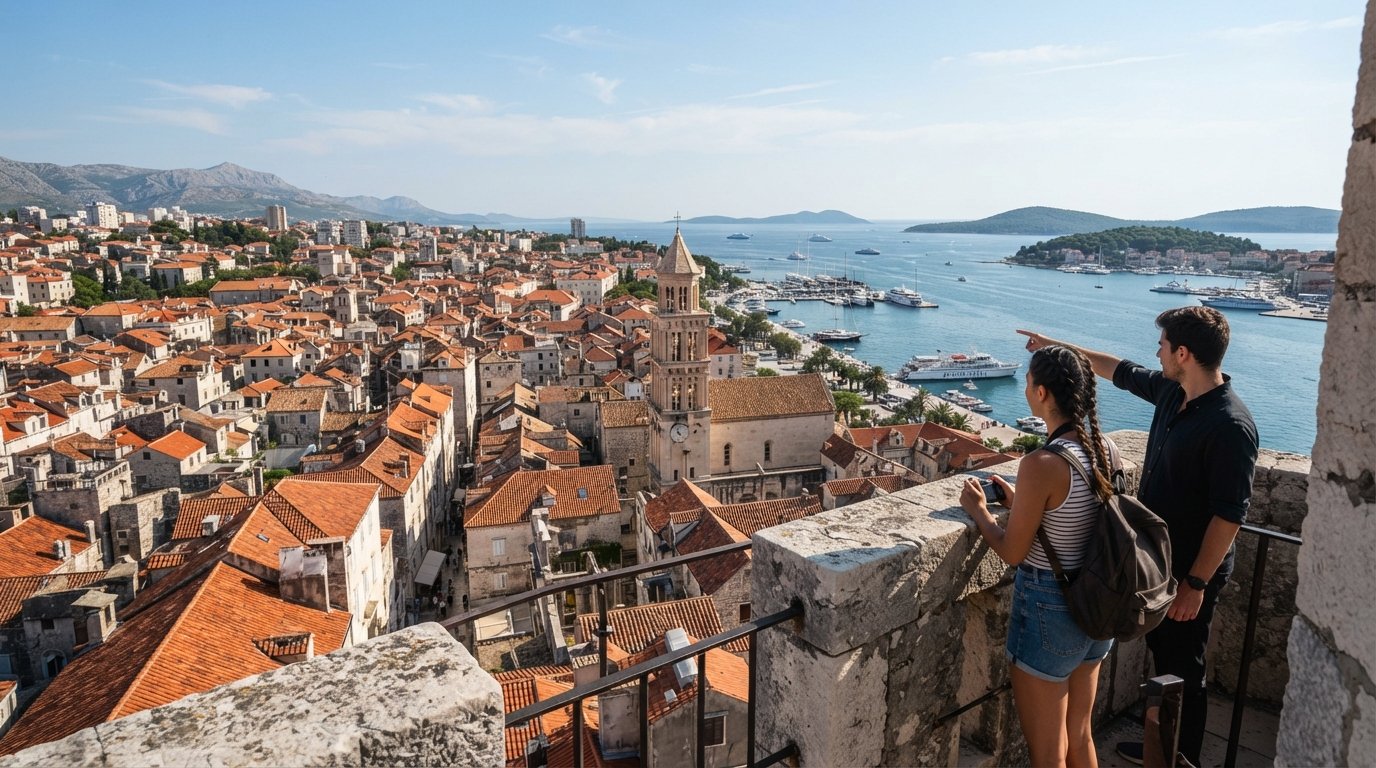
The whole quarter is the attraction, and the best way to handle it is as a wander with anchors. Begin at the Cathedral of St Domnius & Bell Tower first thing if you can. The climb is punishing in the ordinary way old towers are punishing, but the view returns the favour properly: terracotta roofs, the harbour, the islands, and the city laid out as if somebody had once argued with the sea and won.
Then drop into the cathedral itself, originally Diocletian’s mausoleum. An emperor who persecuted Christians now rests beneath a Christian altar. Split does not need to underline the irony; it simply lives inside it. From there, descend into the Diocletian’s Palace Cellars (Substructures) for the cool Roman vaults beneath the palace. The halls are ticketed, a few euros, and they give you a clean sense of the scale of the place — not as a postcard, but as a machine built to hold power.
The Peristyle is worth returning to more than once. By day it is the centre of the old town’s traffic, and by night it can turn into a stage for live music, with the surrounding stone catching every note. Step through the Golden Gate & Gregory of Nin statue and you feel the palace loosen into the city beyond. Rub the bishop’s toe if you like. Plenty of people do.
From there, let yourself drift. The stepped Dosud lane is one of those places where the city’s verticality becomes part of the route rather than an obstacle. The arch-framed vestibule often catches a cappella klapa singers, and the echo makes the whole thing feel older than it is. There is also the joy of the tight passage where a single column has a whole house built around it, which is the kind of improvisation that tells you the neighbourhood was never planned so much as negotiated.
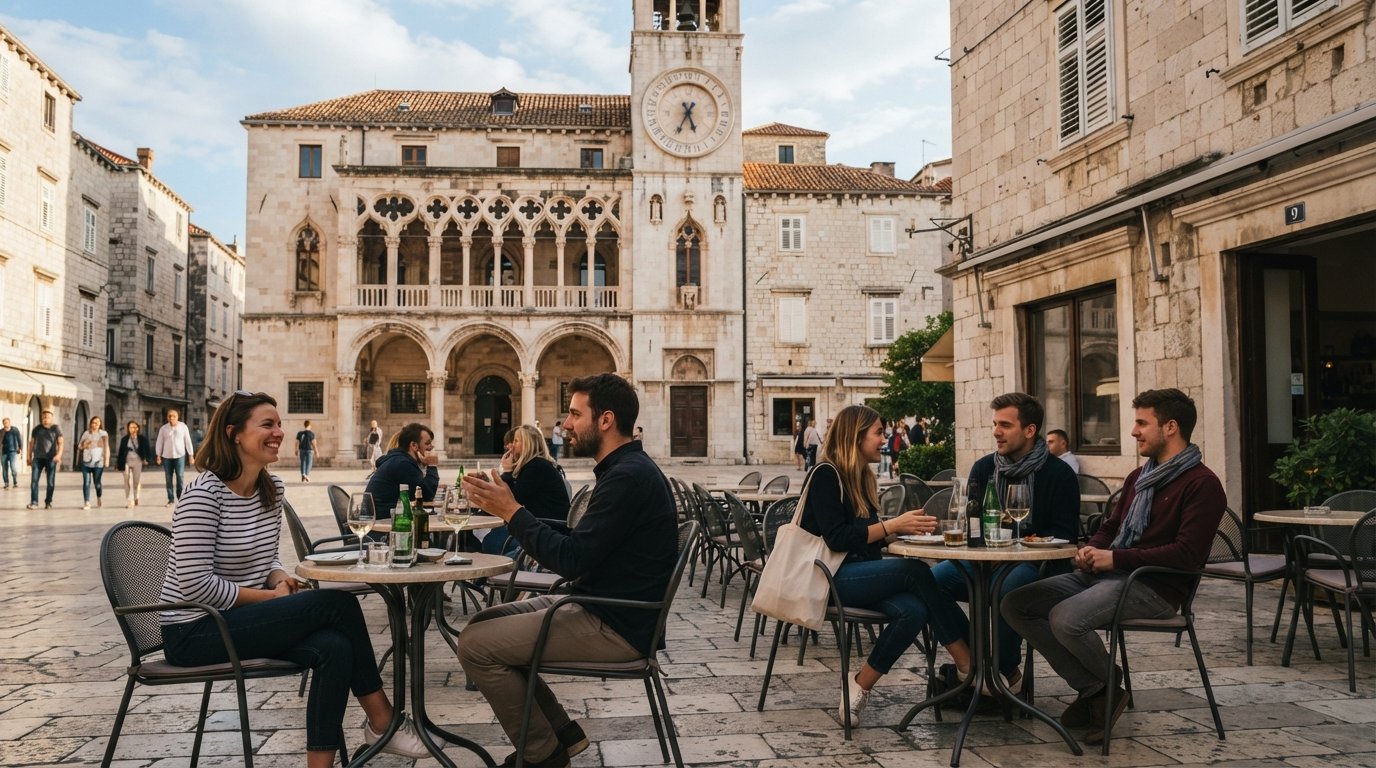
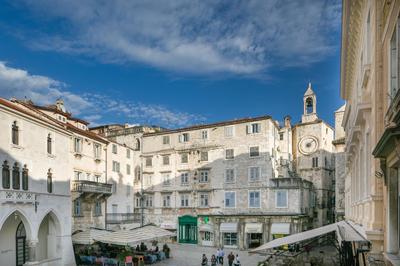
Two open squares just west of the walls are worth the detour. Pjaca (People’s Square) was the first space the city spilled into beyond the palace, and it still makes a good place to sit with coffee and watch the day go by. The Gothic town hall and the Renaissance 24-hour clock give the square its proper frame.
Then there is Fruit Square (Voćni trg), with its octagonal Venetian tower and the baroque Milesi Palace. It is smaller, quieter, and more elegant than the main drag, which is often the way with places that have survived by not shouting.
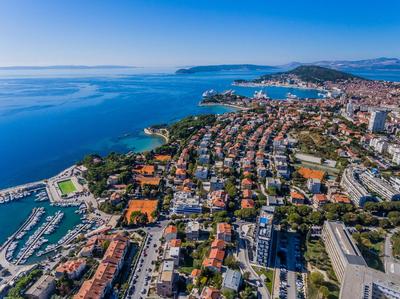
End at the Riva, the palm-lined waterfront promenade that runs along the palace’s sea-facing wall. This is the city’s living room, and at sunset it fills with the ordinary theatre of Split: walkers, ice cream, a little gossip, the harbour light sliding over the water.
Don’t miss in Grad (Old Town)
The Peristyle square
Cathedral of Saint Domnius
The lively Pazar open-air market
Shopping & markets
Skip the magnet-and-lavender-soap stalls on the main lanes if you can help it. The real shopping lives at the edges of the palace, where the markets still serve the city rather than the visitor flow.
Just outside the eastern Silver Gate, hard against the palace wall, the Pazar green market sets up from around 7am. This is where the farmers and cheese-sellers come in with Dalmatian produce, Pag cheese, jars of honey and local olive oil, prosciutto and figs. Go in the morning before it winds down by early afternoon. That is when it still feels like a market and not a memory of one.
Two minutes west, the covered Peškarija fish market on Marmontova is a handsome Revival-style hall from 1890 where the day’s Adriatic catch is sold. Locals will tell you, with a straight face and a shrug, that it has no flies because of the sulphur springs nearby. Whether that is chemistry or folklore hardly matters; the place works.
Between the two, Marmontova carries the mainstream fashion labels, while the palace lanes hold small independents — Croatian olive oil, wine, Dalmatian ties, and a scattering of design and jewellery studios. If you want a proper edible souvenir, buy oil, wine or cheese at the Pazar rather than in a gift shop. The city will thank you for it later, even if the bottle has to sit in your bag all afternoon.
Where to stay in Grad (Old Town)
Sleeping inside the walls is the most atmospheric base in Split and the most compromised. You trade quiet and lifts for waking up in a Roman palace. Rooms tend to be small and reached by stone stairs, cobbles are unkind to wheels, and the lanes near the Peristyle and the bar runs around Dosud can be loud in peak season until the early hours. That is the honest version.
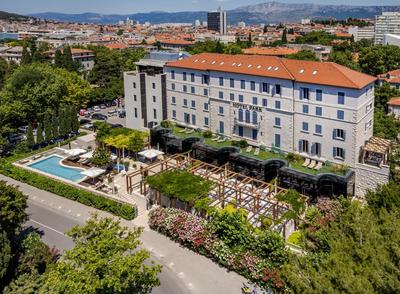
The better version is that you step outside and the whole old town is already there: the cathedral, the Riva, the markets, the cellars, the squares. If you want both atmosphere and a fighting chance of sleep, choose a place a street or two off the busiest squares and ask for a courtyard- or interior-facing room. Heritage boutique hotels built into the palace fabric sit right by the Roman vestibule, but there are also small guesthouses and apartments squeezed into centuries-old buildings. You pay a premium for the address and the history, and that is simply how the maths works here.
Hotels in Grad (Old Town)
Our best-rated stays in this neighbourhood. Prices are approximate “from” rates — confirmed at the provider when you continue. We may earn a commission if you book through our partners — at no extra cost to you.
In this area In this area
 In this area
 In this area
 In this area
 In this area
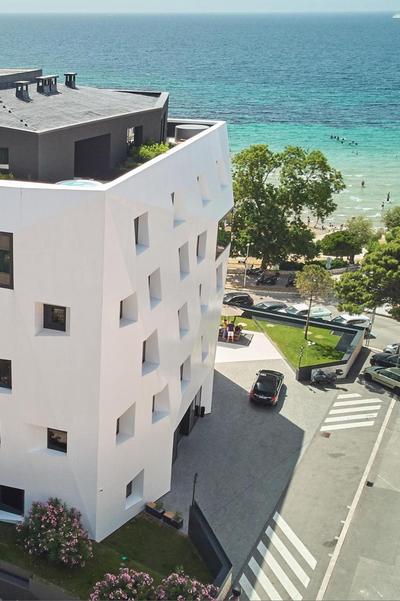 In this area
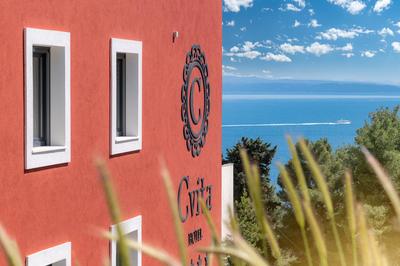 In this area
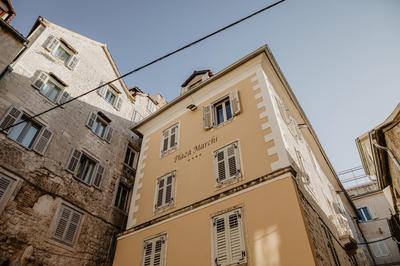 In this area
Grad (Old Town)
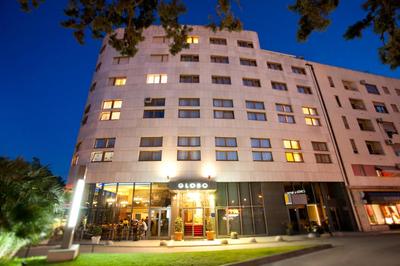
Plaza Marchi Old Town - MAG Quaint & Elegant Boutique Hotels
8.4· 894 reviews
approx. from£98 / nightSee prices
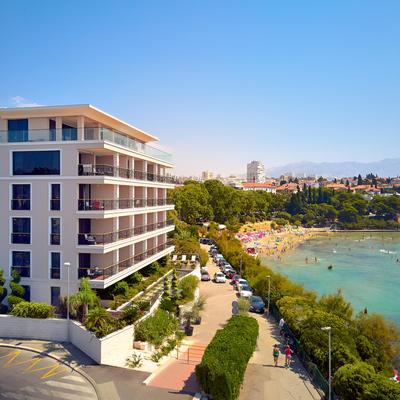 In this area
 In this area
 In this area
Travellers who want the location without the noise or the stairs often stay just outside the walls — a two-minute walk still counts as central — or in nearby Varoš and Bačvice. If you are dragging luggage or travelling with a stroller, that distinction matters more than any postcard promise.
Getting around
Grad is pedestrian-only and tiny. You walk everywhere, and a car is useless inside and unwelcome; leave it in a garage outside the centre. From the Peristyle it is under five minutes on foot to the Riva, and almost every sight, restaurant and market sits within a 15-minute radius of the palace walls. That is the gift of the place. It is compact enough to make you lazy and intricate enough to keep you alert.
The main bus and ferry terminal and the train station are all clustered about 600 metres east along the harbour, roughly a 5–10 minute walk. That makes day trips easy enough, with catamarans to Hvar and Brač and buses to Trogir, Krka and beyond. Split Airport (SPU) sits around 25 km northwest at Kaštela; the airport bus and city bus line 37 both connect to the centre in about 30–50 minutes, and Uber and Bolt operate for door-to-door trips.
Wear real shoes. The Roman paving is slick when wet, and the lanes are stepped and uneven. That is not a warning so much as a fact of life here.
Gallery
Grad (Old Town) in pictures
Grad (Old Town) — your questions
Is Grad (Old Town) a good area to stay in Split?
Yes, if atmosphere and location matter most. You sleep inside a 1,700-year-old Roman palace, steps from the cathedral, the Riva and the markets, and everything is walkable. The trade-offs are small rooms, stone stairs, a price premium and the possibility of late-night bar noise near the main squares. Light sleepers and anyone with mobility or luggage concerns should choose a courtyard-facing room off the busy lanes, or stay just outside the walls and walk in.
Where should I eat inside Diocletian’s Palace?
For the local favourite, go to Villa Spiza on Petra Kružića — a tiny cash-only konoba with a daily market menu and no reservations. Mazzgoon does refined pasta and Adriatic seafood on a hidden courtyard terrace, Bokeria is the buzzy all-day wine-and-Mediterranean room, Fig is best for vegetarian food and brunch, and ZOI on the southern wall is the Michelin-Guide splurge with the best view. Finish with gelato at Luka.
Is Split’s Old Town too crowded?
It gets busy in high season, especially around the Peristyle and cathedral when cruise ships are in port at midday. The fix is timing: walk the palace lanes early morning or after dark, when the day-trippers have gone and the quarter turns quiet and atmospheric. Split is still less overwhelmed than Dubrovnik, and stepping one lane off the main route usually buys instant calm.
Can you get around Grad without a car?
Yes — that is the point. Grad is pedestrian-only and tiny, with the bus, ferry and train hub about a 5–10 minute walk away. Inside the walls, everything is on foot, though you should expect stairs, cobbles and uneven Roman paving.